You’ve probably heard “20/20 vision” used like a gold standard. People often use it to mean flawless eyesight with absolutely nothing to worry about. But that’s not quite what it means, and knowing the difference can change how you think about your eye health.
20/20 vision refers to normal distance clarity, not perfect or complete vision. It’s a helpful starting point, but it’s only one piece of a much larger picture.
What the Numbers Actually Mean
Optometrists use a standardized chart to measure your distance vision. The first number, 20, is the distance in feet you stand from the chart. The second number is the distance at which someone with normal vision reads that same line clearly.
This means if you have 20/20 vision, you can read at 20 feet what a person with normal vision reads at 20 feet. That’s it. Your vision is normal, but it isn’t necessarily flawless.
20/20 Vision vs. Other Vision Levels
Some people actually see sharper than 20/20 vision. If your vision measures at 20/15, you can read at 20 feet what most people need to stand 15 feet away to see clearly. This simply means you have above-average distance clarity, and it does happen naturally for some.
On the other end, vision at 20/40 or worse can start affecting daily tasks. You might find yourself squinting at road signs at night or struggling to recognize faces from afar. In Alberta, non-commercial drivers generally need visual acuity of at least 20/40 with both eyes open, with or without corrective lenses.
In Canada, legal blindness generally means visual acuity of 20/200 or less in both eyes after correction, and/or a visual field of 20 degrees or narrower.
What Can Affect Your Visual Acuity
Many common eye conditions can blur your eyesight and lower your visual acuity. Here are a few common refractive errors that can affect how clearly you see:
- Myopia: This makes distant objects look blurry and often develops during childhood.
- Farsightedness: This can make close-up details harder to see clearly, and in some cases may also affect distance vision.
- Astigmatism: This causes blurred vision at multiple distances due to an irregularly shaped cornea.
- Presbyopia: This is a natural change after age 40 that makes reading fine print up close much more difficult.
Why Good Vision Goes Beyond 20/20
Seeing clearly across a room is only one small part of how your eyes function. Colour vision, night vision, and peripheral vision all play an important role in how you navigate the world. “Perfect” vision is also not an indication of eye health, as eye diseases like glaucoma or dry eye can develop quietly, even when your vision still measures at 20/20.
You might read the wall chart perfectly and still have pressure building in your eye that may damage your optic nerve over time. Diagnosing these issues early can protect your long-term eye health, even if your vision seems to stay the same.

Do You Still Need Glasses with 20/20 Vision?
Yes, you can have 20/20 distance vision and still benefit from glasses. That number only tells you how clearly you see a chart across the room. It says nothing about how your eyes work at close range, how they team together for depth perception, or how comfortable they feel after a long day of screen time.
You might still get headaches, rub your eyes often, or feel discomfort around your eyes or brow after a long day of reading. Some studies show that only about 35% of people naturally have 20/20 vision without any correction.
Glasses or contact lenses can help reduce strain and bring more comfort back to your daily routines.
What to Expect During an Eye Exam
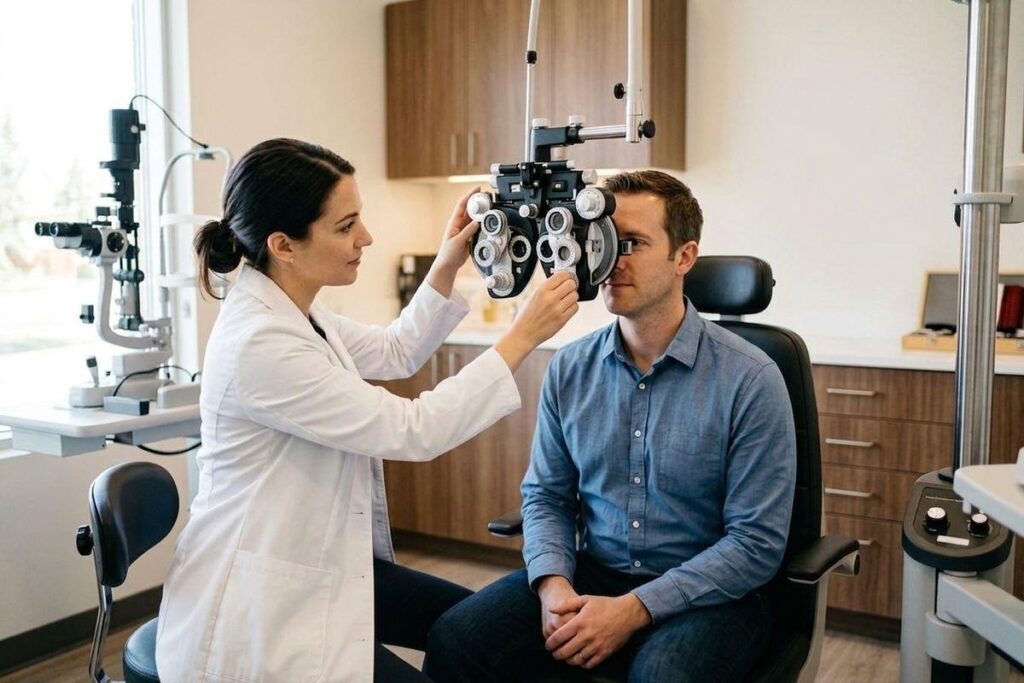
Reading the letter chart is just the beginning of your appointment. During a full exam, the doctor also tests different lens combinations to find your exact prescription and may use autorefraction. This tool measures how light bends inside your eye to get a detailed starting point for your prescription.
Many eye conditions can develop before you notice a change in how clearly you see. Glaucoma, diabetic eye changes, and macular degeneration can all be present before you notice anything different. Comprehensive eye exams can detect what normal vision checks can miss.
Ready to See the Full Picture?
We understand the peace of mind that comes with knowing exactly what’s happening with your vision. A thorough checkup gives you the full picture of your eye health beyond a simple number on a wall.
Whether you need a routine check or have specific concerns about eye diseases, the team at Southwood Eyecare is here to help! Book your comprehensive eye exam today and get the answers you need to support clear, comfortable vision and long-term eye health.